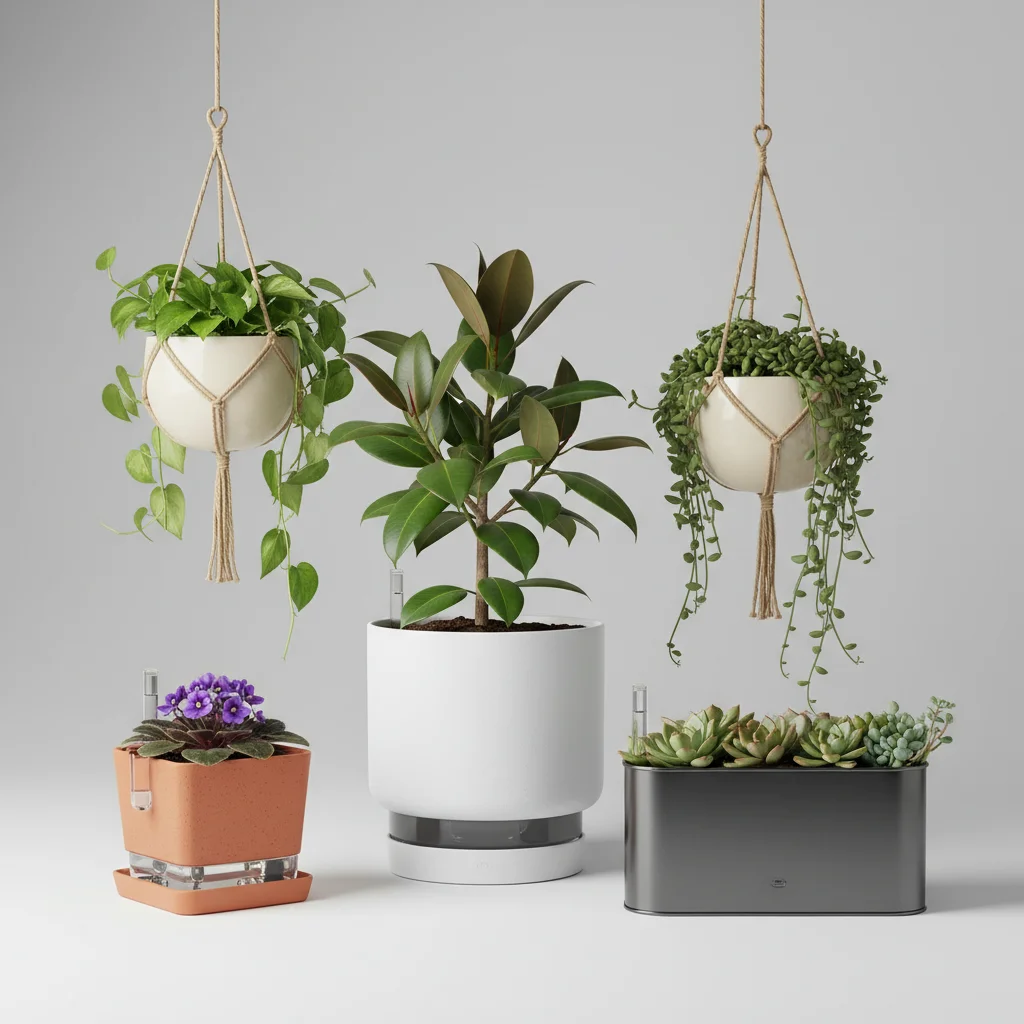
Choosing the right self-watering plant pot can significantly simplify plant care, especially for busy gardeners or those new to houseplants. These innovative pots typically feature a reservoir that supplies water to the plant’s roots as needed, reducing the frequency of manual watering. There are five main types of self-watering plant pots, each offering distinct advantages for various plant species and growing environments.
Understanding How Self-Watering Pots Work
Self-watering plant pots operate on the principle of capillary action. A wicking system, often a string or a porous material, draws water from a reservoir up into the soil, providing a consistent moisture level for the plant. This method prevents both overwatering and underwatering, two common issues that can harm plant health. The reservoir needs to be refilled periodically, but much less often than traditional watering.
Types of Self-Watering Plant Pots
The market offers a variety of self-watering designs. The most common include wick systems, sub-irrigation planters (SIPs), and hydroponic systems. Wick systems are simple, using a string to draw water. SIPs have a larger water reservoir at the bottom, with the soil sitting above it, often with a fill tube. Hydroponic systems, while more advanced, also fall under self-watering as they provide nutrients directly to roots in water.
- Wick System Pots: Ideal for smaller plants and herbs, simple to set up.
- Sub-Irrigation Planters (SIPs): Great for larger plants and outdoor use, offering extended watering intervals.
- Hydroponic Self-Watering Systems: Best for advanced growers, providing precise nutrient delivery.
- Terracotta Spike Systems: Uses porous terracotta to slowly release water into the soil.
- Recycled Plastic Self-Watering Pots: An eco-friendly option, often durable and lightweight.
Benefits for Different Plant Types
|
Our Picks for the Best Plant Pot in 2026
As an Amazon Associate I earn from qualifying purchases.
|
||
| Num | Product | Action |
|---|---|---|
| 1 | Indoor Self Watering Planters with Drainage Holes and Saucers, 8, 7, 6.5, 6, 5.5, 5 Inches, 6 Pots(Green+Brown |

|
| 2 | Kante 18 Inch Dia Round Concrete Planter, Indoor Outdoor Large Plant Pot with Drainage Hole and Rubber Plug for Home Patio Garden, Black |
|
| 3 | Indoor Self Watering Planters with Drainage Holes and Saucers, 8, 7, 6.5, 6, 5.5, 5 Inches, Black, 6 Pots |
|
| 4 | 7 pcs Plant Pots with Drainage Holes and Saucers, Indoor Planters, Set of 7 (7.5, 7, 6.5, 6, 5.5, 4.5, 3.5 Inches), White |
|
| 5 | Indoor Outdoor Plant Pots- Self Watering Planters with Drainage Holes and Saucers, 9,8, 7.5 Inches, 3 Pots (Snow) |
|
| 6 | Kante 18 Inch Dia Round Concrete Planter, Indoor Outdoor Large Plant Pot with Drainage Hole and Rubber Plug for Home Patio Garden, Weathered Concrete |
|
| 7 | Kante 18 Inch Dia Round Concrete Planter, Indoor Outdoor Large Plant Pot with Drainage Hole and Rubber Plug for Home Patio Garden, Charcoal |
|
| 8 | Kante 18 Inch Diameter Round Concrete Planter, Indoor Outdoor Large Plant Pot with Drainage Hole and Rubber Plug for Home Patio Garden, Buff Concrete |
|
| 9 | Indoor Self Watering Planters with Drainage Holes and Saucers, 8, 7, 6.5, 6, 5.5, 5 Inches, White, 6 Pots |
|
| 10 | Indoor Self Watering Planters with Drainage Holes and Saucers, 8, 7, 6.5, 6, 5.5, 5 Inches, Green, 6 Pots. |
|
Self-watering pots are particularly beneficial for plants that prefer consistently moist soil, such as ferns, peace lilies, and many herbs. They are also excellent for plants that are sensitive to inconsistent watering. However, plants that prefer drier conditions, like succulents and cacti, may not thrive in these systems unless carefully managed to prevent root rot. Always research your specific plant’s water requirements before choosing a self-watering pot.
For plants that require consistent moisture, a self-watering pot can be a game-changer. It ensures that the plant receives water as it needs it, preventing the stress of drying out between waterings. This can lead to healthier growth and more vibrant foliage.
Choosing the Right Size and Material
When selecting a self-watering plant pot, consider both the size of your plant and the material of the pot. The pot should be large enough to accommodate the plant’s current root ball and allow for future growth. Materials vary widely, from plastic and ceramic to terracotta and recycled options. Plastic pots are lightweight and affordable, while ceramic offers a more aesthetic appeal. Terracotta, while porous, can still be effective in a self-watering design if the wicking system is robust.
Maintenance and Care Tips
Even with self-watering pots, some maintenance is required. Regularly check the water reservoir and refill it before it runs dry. It’s also important to periodically flush the soil with plain water to prevent the buildup of salts and minerals, which can occur when using only the reservoir. Clean the reservoir and wicking system every few months to prevent algae growth and ensure optimal function.
Get our weekly buyer guide
Practical specs, not advice. Unsubscribe anytime.
